Restaurant Exterior Signage: How to Stand Out in Crowded Atlanta Dining Districts
Atlanta's dining districts are crowded and getting more so. On a good block your restaurant is one of eight choices inside a two minute walk, and most of those choices get made from the street. This guide covers what makes restaurant exterior signage work in that setting, and what quietly stops it working.
Restaurant exterior signage works hardest in a crowded dining district when it is sized for the real viewing distance, lit for night trade, and matched to your cuisine and price level. Channel letters and blade signs suit most Atlanta storefronts. Confirm your landlord criteria and city sign permit rules before you order anything.
Why Restaurant Exterior Signage Works Harder Than Other Storefront Signs
Restaurant decisions are fast. Someone walking Krog Street Market or driving down Peachtree chooses in a few seconds, often from a moving car, often in a group, often already running late. Your sign has to land inside that window.
Three things separate a restaurant from other storefronts:
- The decision is impulsive. Many of your covers did not plan to eat with you tonight. They are picking between you and the places either side of you.
- Your busiest hours are after dark. Dinner service runs when daylight is gone, so an unlit or badly lit sign effectively closes your storefront during your highest revenue hours.
- Diners judge the kitchen by the sign. People read price level, cuisine and care off a sign long before they see a menu. A tired sign suggests a tired kitchen, fair or not.
Signage is the one piece of marketing still working at 8 pm on a Friday, after the ad budget is paused and the posts are buried.
Common Visibility Mistakes in Crowded Dining Districts
Most restaurant signs we get called out to fix in Metro Atlanta fail for one of five reasons.
- Sized for the building, not the viewing distance. Letters that look right on a drawing at arm's length disappear from across Ponce de Leon Avenue.
- Not enough contrast. Dark bronze on dark brick reads as a shadow. Cream on cream is worse. Contrast beats size more often than owners expect.
- Blending into the neighbors. Where every tenant on a strip has a backlit box in the same size and color family, nothing stands out, including you.
- Half the LEDs are out. A sign reading "B STRO" does more damage than no sign at all.
- Clean by day, invisible by night. Vinyl on glass and unlit letters both vanish after sunset, exactly when you need them.
A quick test. Stand where your customer actually approaches from, at the hour they arrive, and see what you can read. Most owners have only judged their sign from the parking space in front of it, in daylight.
Choosing the Right Restaurant Sign Type
There is no single best sign for a restaurant, only the best sign for your frontage, setback, lease and district. Here is how the common options compare.
| Sign type | Best for | Night visibility | Worth knowing |
|---|---|---|---|
| Channel letters | Primary storefront identification | Strong, front or halo-lit | The default for most Atlanta restaurant frontages |
| Blade or projecting | Walkable districts, narrow frontages | Good when lit | Catches sidewalk traffic a flat wall sign cannot |
| Monument or pole | Deep setbacks, suburban pads | Strong when internally lit | Often the only option when the building sits well back |
| Window graphics | Hours, offers, cuisine cues | Low unless backed by interior light | Cheap to refresh, easy to overdo |
| Awning signage | Shade plus identification | Low unless separately lit | Suits patios and restrictive historic districts |
| LED message board | Specials, events, changing offers | Strong | Brightness and change rates capped in several municipalities |
Most restaurants end up with a combination. A typical Atlanta build is channel letters for the name, a blade sign for foot traffic, and restrained window graphics for hours and offers. If you want a changeable display, our LED and digital signs page covers what those involve. The International Sign Association is a useful neutral reference on sign types.
Lighting After Dark: Getting Night Visibility Right
Dinner trade happens in the dark for most of the year, so lighting is not a finishing touch on a restaurant sign. It is half the job.
Face-lit or halo-lit. Face-lit letters push light forward through an acrylic face. They read best at distance and are the safer pick for road frontage. Halo-lit letters have a solid face and throw light back onto the wall, ringing each letter in a glow. Halo looks more upscale and photographs well, which matters for a place that lives on social posts, but it needs a clean, light-toned wall behind it and loses legibility at distance. Many Atlanta restaurants run halo on the patio elevation and face-lit on the road elevation.
Color temperature. The detail owners most often get wrong. Cool white around 5000K reads clinical and makes food-led brands look like a pharmacy. Warmer light, roughly 2700K to 3500K, flatters brick, wood and warm brand palettes.
Even light, or none at all. A sign with dim patches or dead modules looks worse than an unlit sign. If your cabinet or letters still run fluorescent or older LED modules, an LED retrofit relamps the inside without replacing the structure, cutting power draw and service calls.
Showing Cuisine, Price Level and Brand Personality
A diner decides three things from your sign before reading a word of the menu: what kind of food this is, roughly what it costs, and whether it is their sort of place.
- Typeface does the heaviest lifting. A tight geometric sans reads modern and casual. A weighted serif reads established and more expensive. A hand-script reads family-run or craft led.
- Material signals price. Brushed metal, deep returns and halo lighting read higher check average. A flat printed box reads quick service. Neither is wrong, but both have to match what the guest finds inside.
- Restraint reads as confidence. The priciest restaurants in Buckhead and on the Westside tend to have the quietest signs. For a neighborhood taqueria the opposite is true, and color and energy serve you better.
- Stay consistent. Sign, menu boards, patio and packaging should look like one business, so someone who found you on a delivery app recognizes the building when they drive past.
Avoid a sign that promises more than the room delivers. It sets up an expectation the first visit has to walk back.
Patio, Parking and Wayfinding Signs
The storefront sign gets the attention, but the signs around it decide whether a first-time guest arrives relaxed or irritated.
- Patio and sidewalk. A-frame and sidewalk sign rules vary by municipality and are tightly controlled in several walkable Atlanta districts. Check before buying one. A lit blade sign often does the same job permanently and legally.
- Parking. Deck entrances, validation rules and "parking in rear" directions are the biggest first-visit friction point in Midtown, Decatur Square and Virginia-Highland.
- Wayfinding on site. Entrance identification, patio access and restroom direction all take load off your host stand on a busy night.
- Accessibility. Permanent room identification, accessible parking and entrance signage carry requirements under the 2010 ADA Standards for Accessible Design, including character height, contrast and mounting position. Cheaper to get right at build than after a complaint.
Permits and Landlord Rules in Metro Atlanta
Nearly every permanent exterior restaurant sign needs a permit, and in a leased space you are usually clearing two separate approvals rather than one.
- Landlord first. Shopping centers, mixed-use developments and most Atlanta food halls publish written sign criteria covering type, size, illumination and mounting. Get that approval before drawings go to the city, because a city-approved sign your landlord rejects is a wasted submission.
- Then the municipality. Permitted sign area, height, projection and illumination limits vary by city and by zoning district, and sign area is often tied to a percentage of your facade or your linear frontage. The City of Atlanta publishes current sign permit requirements and fees through its zoning, development and permitting services.
- Historic and overlay districts are stricter. Inman Park, Grant Park and several other overlay districts add design review, and internally illuminated signage is sometimes limited.
- Electrical is a separate permit. Any illuminated sign needs one, with a licensed connection.
Altair runs an in-house permit expediter, so the survey, drawings, landlord package and city submission sit with one team instead of bouncing between a designer, a sign shop and your general contractor while your opening date moves.
Permit note: sign ordinances change and differ by municipality and zoning district. The above is general guidance, not legal advice. Confirm current requirements with your city or county, or ask our permit team to check the rules for your address.
A 10-Point Restaurant Signage Audit
Walk your own site with this list. Fifteen minutes tells you whether your signage is earning its keep.
- Can you read the sign from the far side of the road your customers arrive on?
- Can you read it at the hour your dinner service actually starts?
- Does it contrast with the wall behind it, rather than blending into it?
- Are all letters and modules lit, evenly, with no dead sections?
- Is the light warm enough to flatter the building, or is it washing the facade blue?
- Does the sign tell a stranger what kind of food you serve?
- Does it match the price level a guest will find inside?
- Can someone on the sidewalk, walking parallel to your frontage, see any sign at all?
- Is parking or entry direction obvious to a first-time guest, or do they circle the block?
- Does it look maintained? Faded faces, peeling vinyl and surface rust all read as neglect.
Two or more failures and your signage is costing you covers. Our restaurant signs page covers what we design, build and install for Atlanta restaurants.
Talk to Altair About Your Restaurant Signage
Altair Sign & Light has designed, built and installed commercial signage across Metro Atlanta for more than 20 years, from our Smyrna shop. Design and fabrication are in house, we run our own crane and service trucks, our permit expediter handles submissions, and our work carries a warranty on labor and materials.
If your sign is not pulling its weight after dark, or you are fitting out a new space, we will survey the site and walk you through the options.
Call 770.889.1212 or request a free consultation.
Restaurant Signage FAQs
How big does a restaurant sign need to be to read from the road?
It depends on viewing distance and approach speed, not on the size of your building. The further back and the faster the traffic, the taller the letters and the heavier the stroke weight need to be. A survey at your real approach angle settles it in one visit.
Is halo-lit or face-lit better for a restaurant?
Face-lit reads better at distance and is the safer choice for road frontage. Halo-lit looks more upscale and photographs better, but needs a clean, light wall behind it. Many restaurants use both, on different elevations.
What color temperature should a restaurant sign use?
Warmer light, roughly 2700K to 3500K, suits most food-led brands and flatters brick and timber. Cooler white around 5000K tends to read clinical above a dining room.
Will a blade sign work on a narrow frontage?
Usually yes, and it is often the best option there, because it reaches people already walking past. Projection and encroachment limits vary by municipality, so check before design.
How do I tell if my current sign is costing me walk-ins?
Run the ten-point audit above after dark, from your customer's approach. Dead modules, weak contrast and no sidewalk visibility cost the most.
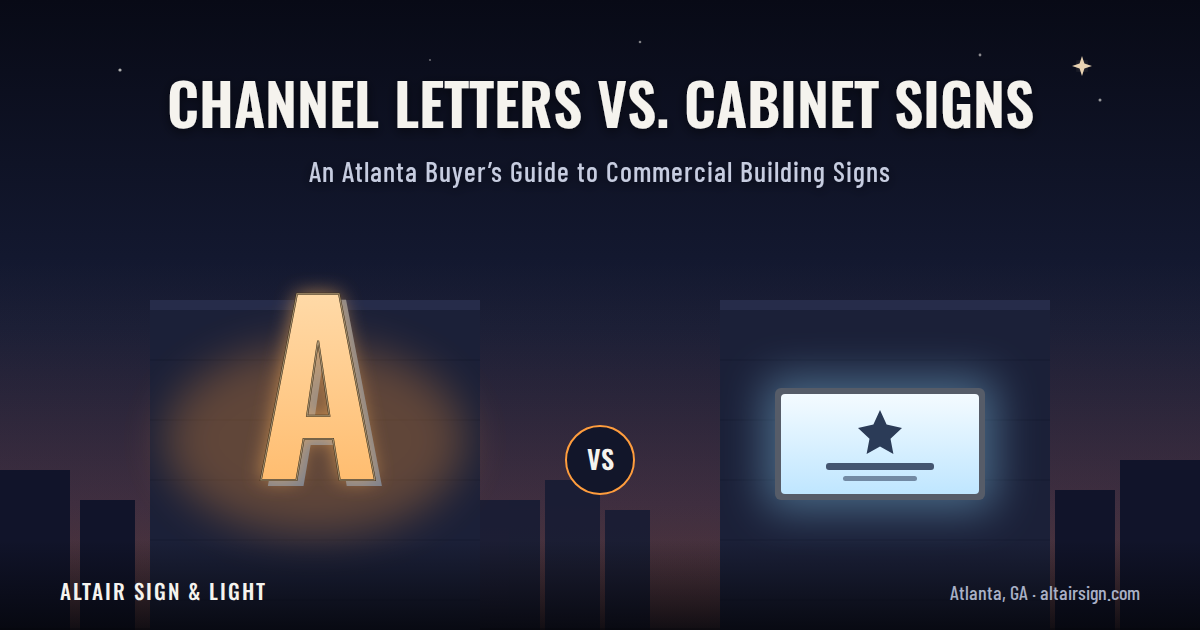
Channel Letters vs Cabinet Signs: Which Commercial Building Sign Is Right for Your Atlanta Business?