Outdoor Restaurant Signs: How to Choose Signage That Attracts More Customers
Signage is not a frequent purchase. Most restaurant owners buy once at opening and again at a rebrand, so quotes are hard to compare. This guide breaks outdoor restaurant signs into what you are actually buying, what each part costs over time, and what has to be cleared before anything goes up.
Every outdoor restaurant sign is four decisions: structure, face, illumination and mounting method. Those four drive the quote, the lifespan and the upkeep. Settle them before comparing prices, because a cheaper quote usually means thinner gauge, a lower grade face or a simpler install rather than a better deal.
What You Are Actually Buying
A sign quote looks like one number, but it is four components priced together. Knowing which is which is what lets you compare quotes.
- The structure: Frame, returns, pole or monument base, usually aluminum. Lasts longest, and the part you are most likely to keep at a rebrand.
- The face: The acrylic, polycarbonate or printed panel carrying your name and logo. Ages fastest, cheapest to replace on its own.
- The illumination: LED modules, power supplies, wiring and controls. Quality here is invisible on day one and decides almost everything later.
- The mounting: Direct, raceway, bracket or footing. Drives the install method, the access equipment and often the permit route.
Start with where the sign has to sit, which the building and lease usually decide for you. That narrows the type, the type narrows materials and mounting, and illumination is the one real choice left. It is also where most of the budget range sits.
Types of Outdoor Restaurant Signs and When to Use Each
| Sign type | Typical materials | Relative lifespan | Maintenance | Install method | Permit complexity |
|---|---|---|---|---|---|
| Channel letters | Aluminum returns, acrylic faces, LEDs | Long, faces age first | Low, letter by letter | Direct or raceway mount | Standard wall permit |
| Cabinet or light box | Aluminum frame, polycarbonate face | Long, face replaceable | Low, reface as needed | Wall or pole mounted | Standard |
| Dimensional HDU | Carved urethane, painted | Medium, needs refinishing | Medium, repaint | Wall fixed or post mounted | Simple if unlit |
| Monument | Aluminum or masonry, acrylic panel | Longest | Low, clean and reface | Engineered ground footing | Footing and setback review |
| Pylon or pole | Steel pole, aluminum cabinet | Longest | Access needs a lift | Engineered foundation | Highest, height and wind load |
| Blade or projecting | Aluminum, acrylic or HDU | Long | Check bracket fixings | Bracket, perpendicular | Projection and encroachment |
| Awning | Aluminum frame, printed fabric | Fabric shortest | Fabric before frame | Frame fixed to facade | Often allowed where lit is not |
| Digital board | Aluminum cabinet, LED display | Long, software dependent | Highest | Into wall, monument or pylon | Brightness and change limits |
Lifespan above is relative, not a promise. Exposure, orientation and servicing move it either way, which is why we talk in ranges on site rather than years on a page. Our outdoor signs page covers what we fabricate, and the International Sign Association is a useful neutral reference on sign types.
Materials That Survive Georgia Weather
Georgia is hard on signage. Humid summers, strong UV most of the year, spring pollen and sudden storms all shorten the life of the wrong specification.
- Powder-coated aluminum. The structural standard for returns, frames, monument skins and posts. It does not rust, and powder coating holds color far better than wet paint in direct sun.
- UV-resistant acrylic. For illuminated faces. Standard acrylic yellows and goes brittle under Georgia sun. UV-stable grades hold color for years longer.
- High density urethane, or HDU. For carved work. Takes detail like timber but does not rot, warp or host insects, so it beats real wood on any rain-exposed elevation.
- Wet-location rated LED modules and power supplies. Sealed and heat-managed. Cheap modules are the most common cause of early failure we find on service calls.
What we steer clients away from outdoors: untreated mild steel, interior-grade vinyl, MDF, and real timber anywhere that takes direct rain.
Designing for Fabrication
A design that looks right on screen can be expensive to build. Three things decide how cleanly artwork becomes a sign.
- Supply the right files. Vector artwork as .ai, .eps or layered .pdf, fonts outlined, brand colors as Pantone references. A JPG or a logo pulled off a website has to be redrawn, adding time and cost before fabrication starts.
- Simple letterforms cost less to build. Letters are fabricated individually, so tight counters, thin strokes and script connections add labor and can push a letter below the depth needed to light evenly. A sturdier version of your brand font costs less and reads better outdoors.
- Contrast changes with the material. A color that works on a printed menu may not hold up as a translucent face, because light passing through a material behaves differently from light bouncing off it. Brand reds and deep blues need checking against a lit sample.
We render the sign on a photo of your building before anything is cut, which is the cheapest point to change your mind.
Lighting: Module Quality and What to Specify
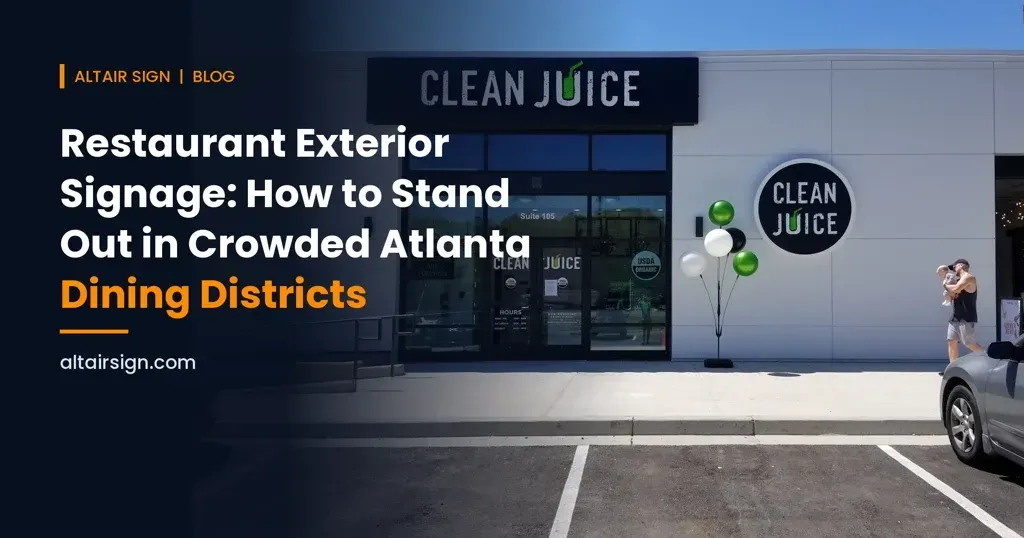
Halo versus face-lit is a design question, covered in our guide to restaurant exterior signage in Atlanta dining districts. From a buying point of view, three specifications matter.
- Module grade and warranty. LED modules vary widely. Ask what is being fitted, and whether the module warranty is separate from the warranty on the sign.
- Weather sealing and heat. Wet-location rated components, sealed seams, correct weep holes and enough ventilation to keep heat off the modules. This is the difference between a sign still lighting evenly years later and one that goes patchy early.
- Digital display limits. Brightness and how often the message may change are capped in several Metro Atlanta municipalities. Confirm the local rule before specifying the display, not after.
Two things people forget: a timer or photocell so the sign is not running at 3 am, and safe service access, because a sign nobody can reach stays broken.
What Affects Cost, and How to Compare Three Quotes
We quote per project, because two signs of the same size can differ substantially depending on what sits behind them. These factors move the number.
- Size and letter count. Letters are priced individually, so a long name costs more than a short one at the same height.
- Materials and gauge. Heavier aluminum, UV-stable faces and custom color matching all cost more, and all last longer.
- Illumination. Unlit is cheapest, face-lit is standard, halo and combination cost more and need greater depth.
- Mounting height and access. Ground-level work needs a bucket truck at most. High-rise or over-sidewalk work needs a crane, sometimes traffic control.
- Electrical. New circuits, timers and a licensed connection are a real line item on any lit sign.
- Permits. Municipal fees vary, and freestanding signs may need engineered drawings.
- Structure. A wall sign on accessible brick is straightforward. A monument or pylon needs a footing designed for local wind load.
What every quote should spell out
Three quotes are only comparable if they describe the same thing. Ask each supplier to state:
- Aluminum gauge and finish, including whether it is powder coated
- Face material and grade, specifically whether the acrylic is UV-stable
- LED module make, and the warranties on modules, labor and materials
- Mounting method, and what structural work is included
- Whether electrical work and the licensed connection are in scope
- Whether permit fees, drawings and the submission are included
- What access equipment is allowed for, and who pays if more is needed
- Who services the sign afterwards, and the response time
A quote that is substantially cheaper is usually cheaper on items 1, 2, 3 or 6. Ask which.
Permits by Sign Type and What a Permit Package Contains
Permit routes differ by what you are putting up. Landlord approval is a separate step that comes first. This section covers the municipal side.
- Wall signs and channel letters. The most straightforward route. Reviewed against permitted sign area, usually tied to a percentage of your facade or to linear frontage.
- Monument and pylon signs. More involved. Setback, height and a designed footing come into it, and wind load calculations are frequently required.
- Projecting and blade signs. Reviewed for projection distance and sidewalk clearance, sometimes with an encroachment approval where the sign crosses the property line.
- Any illuminated sign. A separate electrical permit and a licensed connection, whatever the type.
A complete package normally contains scaled drawings with sign area calculations, an elevation showing the sign on the building, a site plan for anything freestanding, structural and footing details, electrical details, the landlord's written approval, and the application with fees. The City of Atlanta publishes current requirements and fees through its zoning, development and permitting services.
Permit note: sign ordinances change and differ by municipality and zoning district. The above is general guidance, not legal advice. Confirm current requirements with your city or county, or ask our in-house permit expediter to check the rules for your address.
From Survey to Install: How the Process Runs
Knowing the sequence helps you plan, because permitting is the least predictable stage.
- Site survey. We measure the frontage, check the substrate and electrical supply, and photograph the elevation. Sign type and mounting are decided here, not in the office.
- Design and rendering. Artwork set to scale and shown on a photograph of your building, with sign area checked against what the zoning allows.
- Permit package and submission. Drawings, structural and electrical details and the landlord approval go in together, handled by our in-house permit expediter.
- Fabrication. Built in our own Smyrna shop rather than subcontracted. Illuminated signs are built to the electric sign standard, UL 48, which covers construction and safety for electric signs under the National Electrical Code. Inspectors look for it, and listed components inside an unlisted assembly is not the same thing.
- Installation. Our own crane, service trucks and crew, so the people on site built the sign.
- Handover and warranty. The work carries a warranty on labor and materials, and we service what we install.
Altair handles design and manufacturing in house, which keeps the drawings, the build and the crew on the same page.
Maintenance and Lifespan
A well specified sign gives years of service, but it is not fit and forget.
- Structure outlasts everything else. Aluminum frames, monument bases and poles are usually still sound long after the parts in front need attention.
- Faces go first. Printed vinyl and translucent faces fade under UV before anything structural fails, and refacing costs far less than replacing the sign.
- LEDs dim rather than die. Modules lose output gradually, so a sign looks dull before anything has failed. Mixed old and new modules show as patchy brightness.
- Clean it. Pollen, road film and nesting debris reduce light output and look neglected. An annual clean does more than owners expect.
- Catch faults early. One dead module is a quick fix. Left alone, moisture and heat spread it. We repair and service commercial signs across Metro Atlanta, including signs we did not build.
Get a Free Quote from Altair Sign & Light
Altair Sign & Light has designed, built and installed commercial signage across Metro Atlanta for more than 20 years, from our Smyrna shop. Design and fabrication are in house, we run our own crane and service trucks, our permit expediter handles submissions, and our work carries a warranty on labor and materials.
Fitting out a new restaurant or replacing signage that has aged out, we will survey the site, show you the options that suit your frontage and lease, and give you a quote that spells out what is included. Our restaurant signs page shows the range of work we do.
Call 770.889.1212 or request a free quote.
FAQs
What drives the cost of an outdoor restaurant sign?
Size and letter count, aluminum gauge and finish, face grade, illumination type, mounting height and access equipment, electrical work, and permit fees. Two quotes for the same sign usually differ on gauge, face grade, LED quality or whether permits are included.
How long do outdoor restaurant signs last?
Not all of a sign ages at the same rate. Aluminum structure outlasts everything else, translucent faces fade first under UV, and LED modules dim gradually rather than failing outright. Exposure, orientation and servicing all move it, so we assess per site rather than quote a number.
What materials hold up best in Georgia weather?
Powder-coated aluminum for structure, UV-resistant acrylic for illuminated faces, and HDU for carved work. Humidity, heat and strong UV shorten sign life here, which is why untreated steel, MDF and real timber are poor outdoor choices.
What makes a sign genuinely weatherproof?
Less the material than the detailing. Wet-location rated modules and power supplies, sealed seams, correctly placed weep holes so condensation drains, and ventilation to keep heat off the electronics. Most water damage we find came in through a seam or a cable entry, not the face.
Should I repair my existing sign or replace it?
Repair if the structure and electrical are sound, because refacing a panel and relamping costs far less than a new sign. Replace if the frame is corroded, the mounting is unsafe, or the sign no longer fits the brand. We check the structure and wiring first and tell you which way it falls.
Channel Letters vs Cabinet Signs: Which Commercial Building Sign Is Right for Your Atlanta Business?