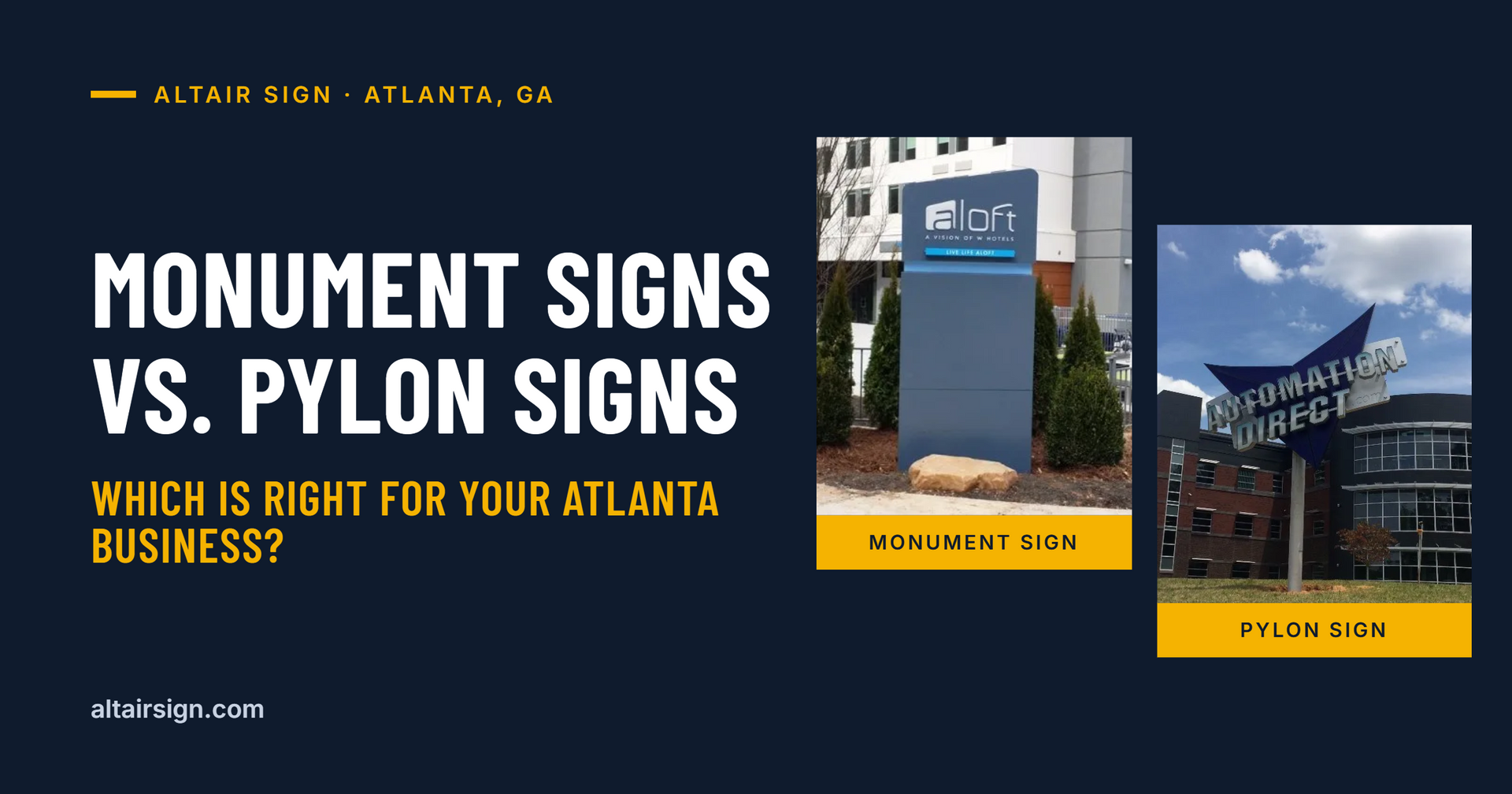
Monument Signs vs. Pylon Signs: Which Is Right for Your Atlanta Business?
Quick answer Go for a monument sign when your building is close to the road, and you want entrance level branding for one business or a campus. Go for a pylon sign when you need to be seen from a distance by faster traffic. Or when several tenants have to share one sign.
Most business owners comparing monument signs vs pylon signs are concerned about only one thing. Where will my customers see me first?
Both are freestanding signs. So, both stand on their own foundation instead of on the building. But the difference is height and purpose.
A monument sign is low and solid. It reads best while someone is walking or driving past at a slow speed.
A pylon sign (which is also called a pole sign, or simply a "pylon") stands higher on supports. So, it stays visible beyond parked cars, hedges, and other buildings.
For businesses in Atlanta, Smyrna, and the wider Metro Atlanta area, which sign type you should go for also depends on what your local sign ordinance allows on that specific property.
What is a monument sign?
A monument sign is a freestanding sign built close to the ground. The base is usually brick, stone, stucco, or fabricated aluminum, and it is matched to the building it serves.
Typical height is around 5 feet. Taller ones in the range of 8 to 12 feet are common for hotels, hospitals, schools, and office campuses. These properties have a wider approach, so the sign has to be readable from further away.
The sign face sits at eye level. So, the finish matters much more than people expect.
Business monument signs are usually built with push-through acrylic letters, routed and backed faces, dimensional letters, or a changeable panel. The material palette normally follows the same logic as the property's architectural signs.
An illuminated monument sign can be lit from inside or lit from the ground with flood fixtures. But, on some properties, an unlit sign is the better answer. Either the ordinance restricts illumination, or the property style simply calls for it.
There is also a second job a monument sign does, and it is easy to miss. It marks the entrance. If your property has two driveways, a monument sign at the correct one saves your customers a U-turn.
What is a pylon sign (also called a pole sign)?
A pylon sign is a freestanding sign carried on a visible support structure. This is why Altair lists it as a pole sign. Height usually starts around 20 feet and goes up from there, within what the local code permits.
The height is the whole point. A pylon sign is built to be read over parked vehicles, landscaping, and single-story buildings. Often by traffic that is moving at 40 mph or more.
Pylon signs are also the standard answer for shared properties. One cabinet can be split into stacked tenant signs, with the anchor tenant panel at the top and smaller panels below it.
So, when a lease turns over, only that one panel is removed and replaced. The rest of the sign is left untouched.
Monument signs vs pylon signs: what is the difference?
A monument sign is a low freestanding sign, usually about 5 feet tall, built on a solid base at the entrance to a property. A pylon sign is a freestanding sign raised on poles, usually 20 feet or taller, built for long distance visibility and for showing several tenant names on one structure.
| Monument sign | Pylon (pole) sign | |
|---|---|---|
| Typical height | Around 5 ft, up to 8 to 12 ft for larger campuses | Around 20 ft and up, within code limits |
| Typical height | At the driveway or property entrance, close to the curb | Set back from the road, visible across a parking lot |
| Best for | Single tenant sites, campuses, professional offices | Multi-tenant plazas, highway and off ramp sites |
| Tenant capacity | One business, sometimes two | Several stacked panels |
| Driver visibility | Strong at slow speeds and short range | Strong at speed and long range |
| Curb appeal | High, blends into landscaping and building materials | Functional, reads as a landmark rather than an accent |
| Permitting complexity | Usually simpler, but setback still governs | More involved, height and engineering get closer review |
| Relative cost | Lower at the same sign face area | Higher, because of the structure and foundation |
| Illumination options | Internal, external flood, halo lit, or unlit | Internal cabinet lighting, LED message center, or unlit |
What do monument and pylon signs have in common
The two are closer than the height difference suggests.
Both are freestanding. So, both need a foundation, an electrical run if they are lit, and their own permit. Both are fully customizable in shape, size, materials, and color. And both can be lit from inside, lit from outside, or left unlit.
Both also carry the same sign elements. Channel letters, cabinets, routed faces, and LED message centers work on either type.
So, the decision is really about placement and sight lines. It is not about which features you can have.
When to go for a monument sign
A monument sign is usually the better fit when:
- One business occupies the site, or the whole site is a campus under one brand.
- Traffic in front of your property moves slowly, or there is steady foot traffic.
- Your building already sits close to the road, so extra height buys you very little.
- The sign has to mark one specific entrance on a property with more than one driveway.
- The property style, an overlay district, or an HOA favors a low profile sign.
- You want the sign materials to carry through the building materials. This is often the brief on schools, hospitals, hotels, and professional offices.
When to go for a pylon sign
A pylon sign is usually the better fit when:
- Your property has several tenants, and each one needs to be named.
- There is a deep parking lot between the road and the building.
- Traffic moves fast, so drivers need to read and decide much earlier.
- The site is near a highway, an off ramp, or a major arterial road.
- Neighboring buildings, mature trees, or a change in grade block the view of your building.
- The property is a business park, and visitors are looking for one specific unit.
If you manage several properties, a pylon sign also makes turnover simpler. A panel change becomes a scheduled service visit instead of a new sign project. This is part of how Altair runs sign programs for property management portfolios.
Zoning, permits, and Atlanta area sign regulations
This is the part that changes the answer most often. And it is usually the part owners find out about last.
Sign height regulations are set by the jurisdiction that governs your property, not by the state. Height limits, allowed sign face area, how many freestanding signs one lot may have, setback from the right of way, and illumination rules all vary. The City of Atlanta, the City of Smyrna, and unincorporated Cobb County each have their own rules, and so does every other city in Metro Atlanta.
So, two properties on opposite sides of the same road can fall under completely different limits.
A few things are worth knowing before you commit to a design:
- The same sign is not legal everywhere. A 20 ft pylon that is fine on one corridor may be over the limit a mile away.
- Setback drives placement. Your sign has to sit behind the right of way line. That line is often further back from the curb than owners expect. And even a fully compliant sign can be rejected if it blocks the view of oncoming traffic at a driveway.
- Freestanding signs need engineering. Most jurisdictions want a sealed foundation plan, plus a site plan prepared by a licensed surveyor or engineer.
Start with the official source for your own jurisdiction:
- City of Atlanta sign application packet and sign ordinance, issued through the Department of City Planning, Office of Buildings.
- City of Smyrna Planning and Zoning Division, which issues permits for permanent signs, including monument signs.
- Cobb County Zoning Division, which governs unincorporated Cobb County.
This requirement is one practical reason to work with an Atlanta sign company instead of an out-of-state fabricator. Altair keeps a full-time permit expediter on staff. So, the survey, the drawings, the application, and the follow-up with the plan reviewer all sit on our side of the table.
In practice, this means we check the limits for your property before we design to a height. Not after a rejection.
Rules do change, and ordinances get amended. So, please verify the current requirements with your local jurisdiction. Or you can ask us to verify the requirements for your address as part of the quote.
What drives the cost of a freestanding sign
We do not publish prices. Two signs of the same height can differ widely in cost, so a price list would only mislead you.
These are the factors that actually move the number, on a monument sign and on a pylon sign both:
- Size: Sign face area, and overall height.
- Materials: Fabricated aluminum, brick or stone veneer, stucco, acrylic faces, and the finish system.
- Foundation and engineering: Soil conditions, footing depth, and sealed structural drawings. A pylon sign carries much more of this than a monument sign.
- Lighting: Internal LED, external flood fixtures, halo lighting, or an LED message center.
- Electrical run: How far your sign sits from the nearest usable power source, and whether the trench has to cross paving.
- Permits and surveys: Jurisdiction fees, survey work, and any variance application.
- Site access: A pylon install often needs a crane and a traffic plan. Both affect cost and scheduling.
Over the life of the sign, also keep a budget for panel changes, module replacement, face cleaning, and the occasional storm or vehicle repair.
Ask us for a quote, and we will price the realistic options for your site. Not just one design.
Five questions to ask before you decide
- Setback: How far back from the curb does your jurisdiction want the sign to sit? And at that position, is your building still screening it?
- Traffic speed: How fast is traffic moving in front of your property? How much reading time does a driver actually get?
- Tenant count: How many businesses need to be named on the sign today? And how many in five years?
- Ordinance limits: What is the maximum height and sign face area allowed on your specific property?
- Budget: What is the figure for the sign itself? And is there room in it for the foundation, electrical, and permit work that comes along with it?
If your answers point in two different directions, that is useful too. Some properties are best served by a pylon sign at the road, plus a smaller monument sign at a secondary entrance.
Altair has designed, built, and installed commercial signs across Metro Atlanta for more than 20 years. That includes work at Mercedes-Benz Stadium, Truist Park, and State Farm Arena.
The same in-house team handles design and manufacturing and sign installation. So, the permitting and engineering questions get answered before fabrication starts. Not after a crew is already on site.
Get a free quote and site consultation
Tell us about the property, the brand, and the date you need to be visible. We will check the sign rules for your property, and put the scope and timeline in writing for you.
We are a Smyrna sign company with fabrication and dispatch in one place. So, we serve Atlanta, Smyrna, and the wider Metro Atlanta area.
Call 770.889.1212 or request a free quote.
Altair Sign & Light, Inc. 2600 Mathews St SE, Smyrna, GA 30080 770.889.1212
Frequently Asked Questions
What is the main difference between a monument sign and a pylon sign?
Height and purpose. A monument sign is low, solid, and built at the entrance for close range reading. A pylon sign is raised on poles for long range visibility, and it usually carries more than one tenant name.
Which sign is better for my location?
It depends on three things. Traffic speed, how far your building sits from the road, and what is blocking the view of your property. Slow traffic and a building close to the curb favor a monument sign. A deep parking lot or fast traffic favors a pylon sign.
Can a monument sign work for a multi-tenant property?
It can, for two or three tenants on a small property. But, panel space runs out quickly. For a plaza or a strip center with several tenants, a multi-tenant pylon sign with stacked panels is the practical choice.
Do I need a permit for a freestanding sign in Metro Atlanta?
Yes, in effectively every jurisdiction in the area. Expect a sign permit, usually an electrical permit as well, a site plan, and engineered foundation drawings. Requirements vary by city and county, so please confirm them for your own address.
How customizable are these signs?
Both types are built to order. Shape, size, materials, colors, letter style, and lighting are all open. The main constraints are the ordinance limits for your property, and the structural requirements for the height you want.
Can I upgrade a monument sign later with an LED message center?
Often yes. It depends on two things. Whether the structure and the electrical supply can carry it, and whether the ordinance permits a changeable message sign at that location. So, we assess the existing cabinet, foundation, and power before quoting an upgrade. We do not assume it will fit.


Channel Letters vs Cabinet Signs: Which Commercial Building Sign Is Right for Your Atlanta Business?